The Problem With Inter-Universal Teichmüller Theory
A Very Brief Computational Exposition

The primary goal of the Reciprocity Project is to show ‘how things work’ in contemporary number theory through concrete computational examples. This tutorial is different in that it is concerned with some mathematics about which many folks, myself included, have some misgivings.
For a few years, I tried to make sense of Inter-Universal Teichmüller Theory. I visited Shinichi Mochizuki several times, and attended a few IUT conferences. After spending quite a bit of time on the theory, I eventually concluded that I agreed with the basic criticisms that Scholze and Stix had given.
What is abc?
Let’s review the abc conjecture. We begin with positive integers a, b, and c that are coprime, where
Next, we consider the radical of abc, which is the product of all primes that divide abc:
The conjecture states that, given some
there are finitely many triples (a,b,c) such that
Thus, we can regard abc as a statement regarding the relationship between addition and multiplication. The additive ‘building blocks’ of c are a and b, and the multiplicative ‘building blocks’ of abc are the primes that divide abc.
A “Non-Scheme-Theoretic Gluing”
IUT pursues the notion that ‘abc is about multiplicative and additive structure’ in a highly abstract way. The gist of the IUT proof strategy is the idea that one can try to decompose scheme theory into its underlying multiplicative and additive structures in order to see how interconnected they are. One performs this decomposition by using a “non-scheme-theoretic mapping” which preserves multiplicative structure but breaks additive structure, and then tries to reconstruct the additive structure using techniques from anabelian geometry. Ultimately, the extent to which multiplication and addition cannot be fully separated from one another, if quantified, can be formulated in terms of the abc formula to prove the conjecture. So, that’s the idea: transform abc into an anabelian geometry problem.
The main issue is this “non-scheme-theoretic mapping”. For q-parameterized elliptic curves, for which data structures, called Hodge theaters, are constructed, the non-scheme-theoretic mapping between data in different Hodge theaters is as follows:
Why is this a “Teichmüller theory”? Throughout IUT, an analogy is drawn between the multiplicative and additive structures of a ring and the real and imaginary dimensions of ℂ. This, preservation of multiplicative structure but deformation of additive structure is likened to a quasi-conformal mapping, which effects one dimension but not the other:
An example of a quasi-conformal mapping is shown below in the case of ξ=2:
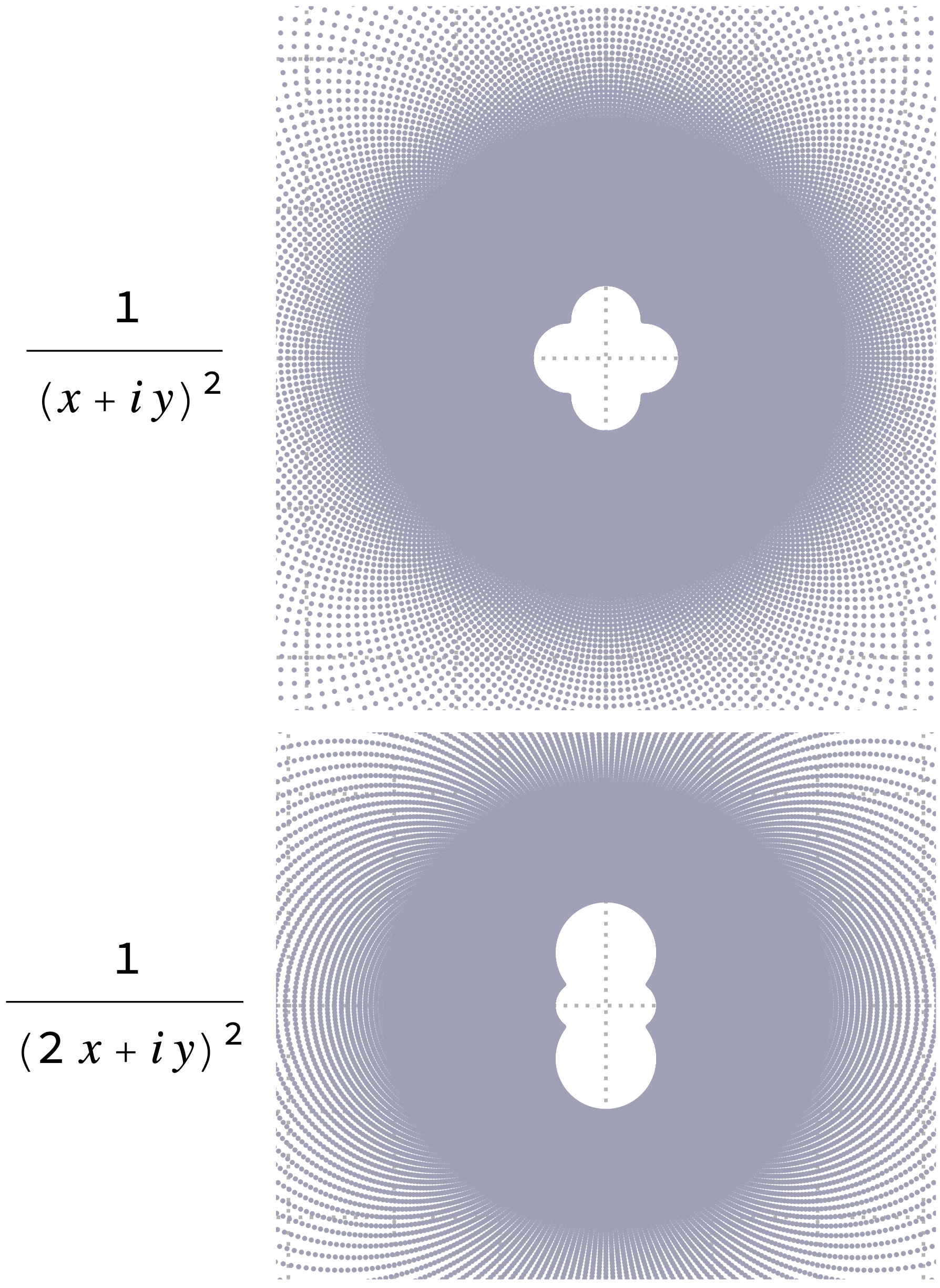
However, this non-scheme-theoretic mapping is part of an “inter-universal” Teichmüller theory, mapping between different Hodge theaters. The key problem is that this mapping is used as a ‘gluing’ or an identification, between data in different Hodge theaters. However, the image and pre-image of this map are not always equal. We know this will be the case, because the mapping doesn’t preserve additive structure. So, that’s what’s so peculiar about IUT: it tries to decompose ring structure into its underlying additive and multiplicative structures by identifying data that are not actually equal.
Loss of Additive Structure
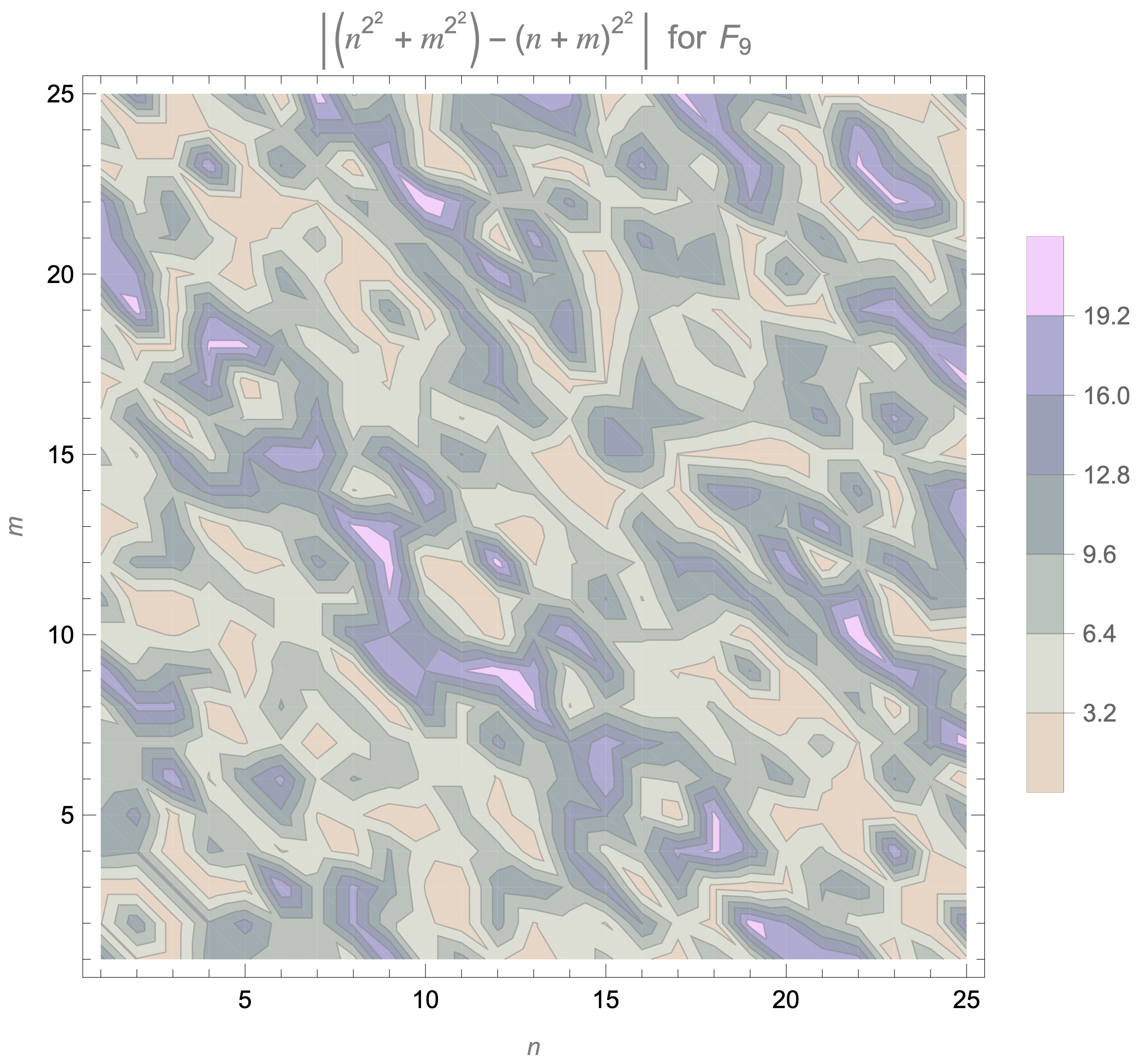
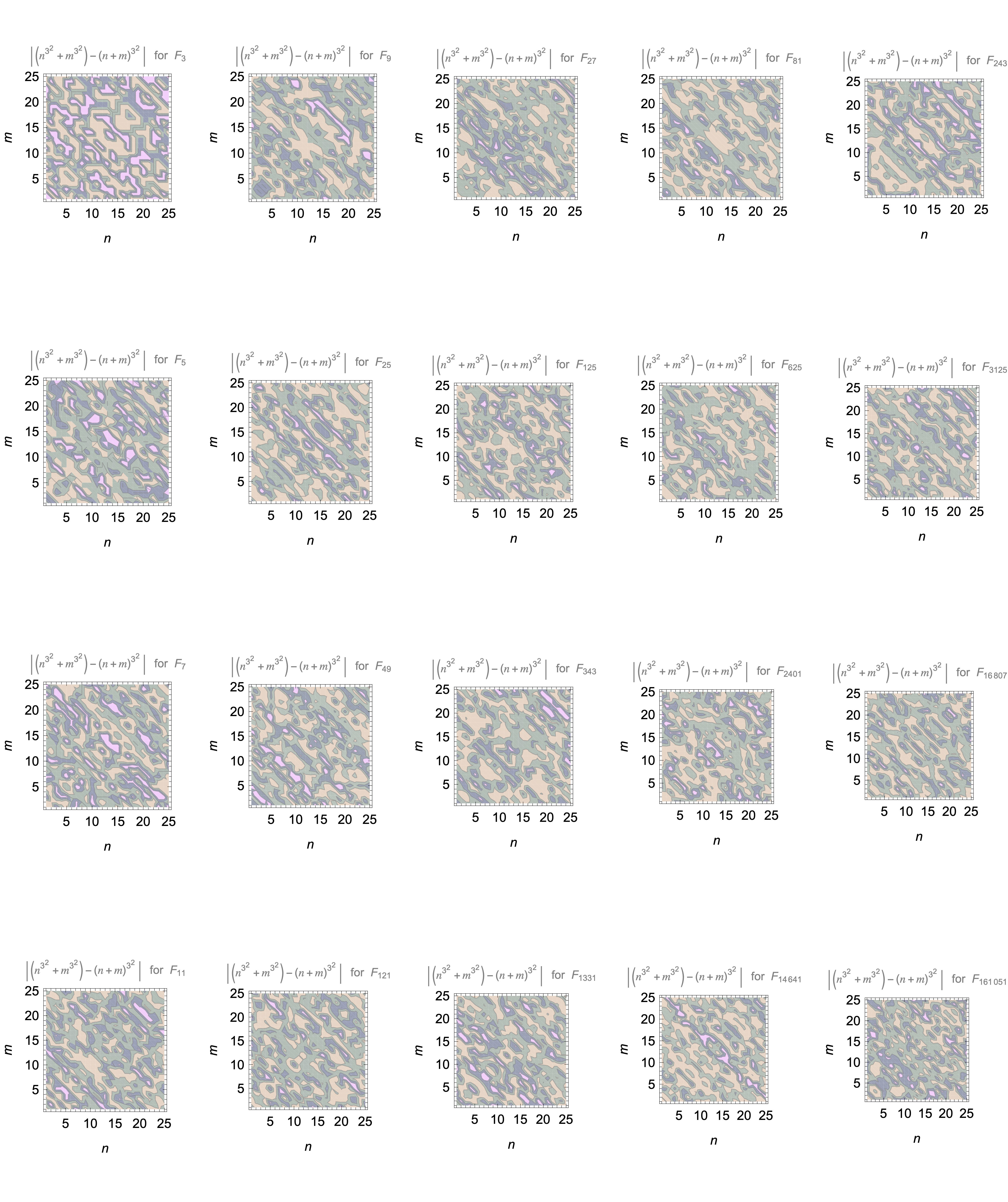
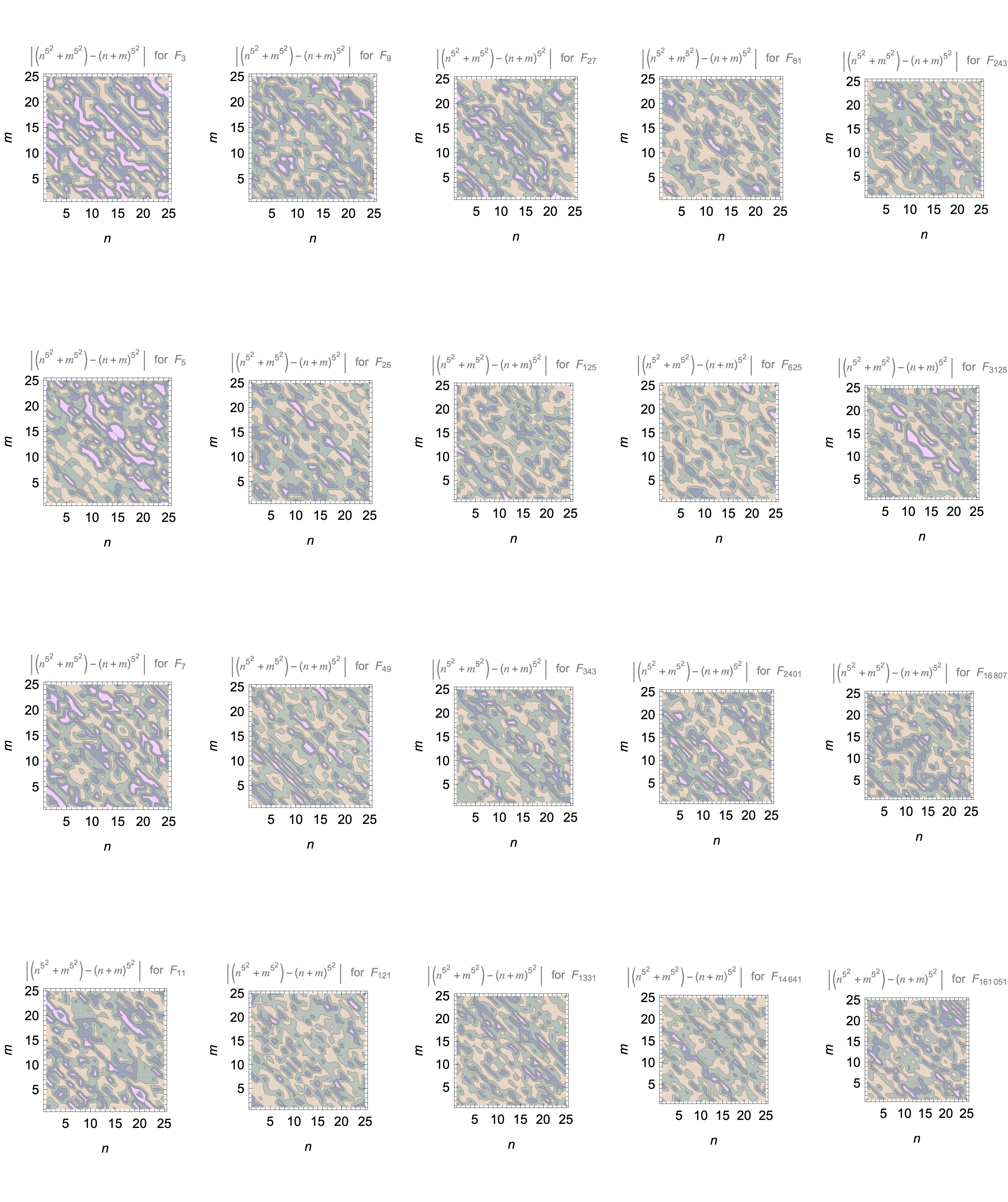
The non-scheme-theoretic mapping significantly breaks additive structure. To see how additive structure is lost, one can just look at what happens under the non-scheme-theoretic mapping. Consider the following additive error term:
Let’s take the finite field
and set j=2. The errors for 1≤n≤25, 1≤m≤25 are plotted as follows:
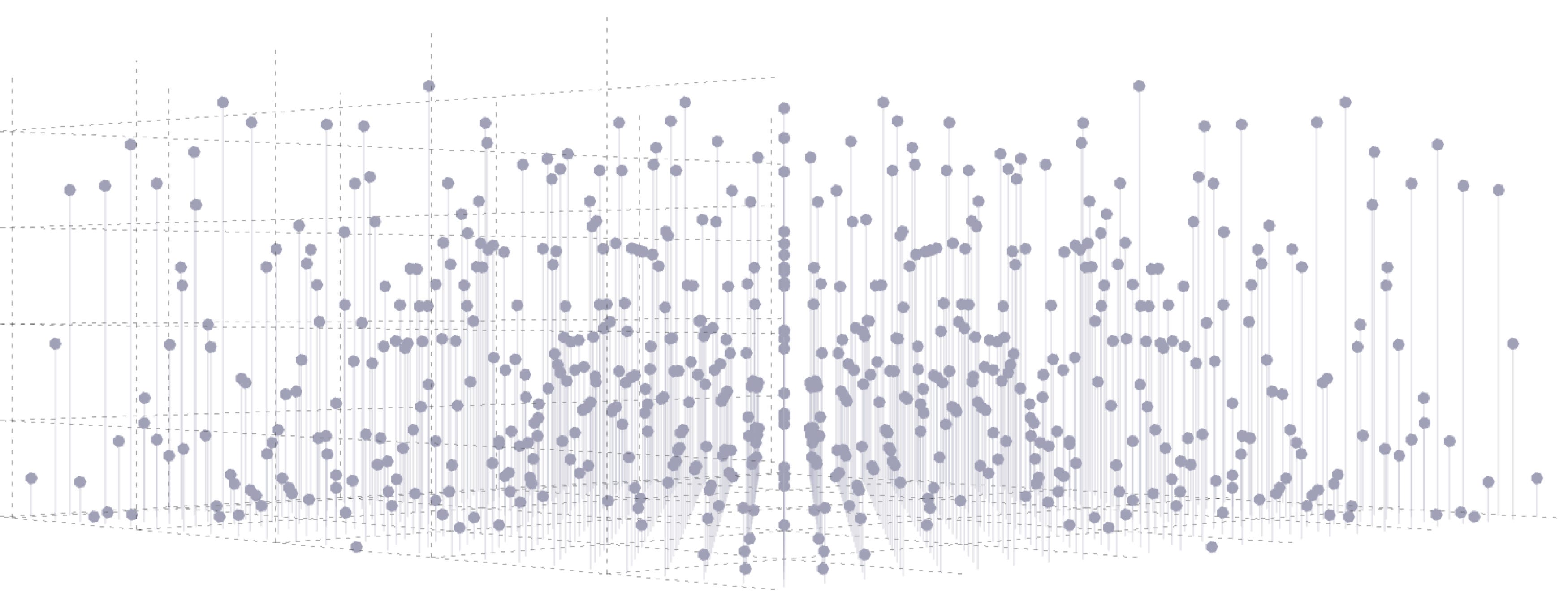
Alternatively, the error can be plotted on a vertical axis:
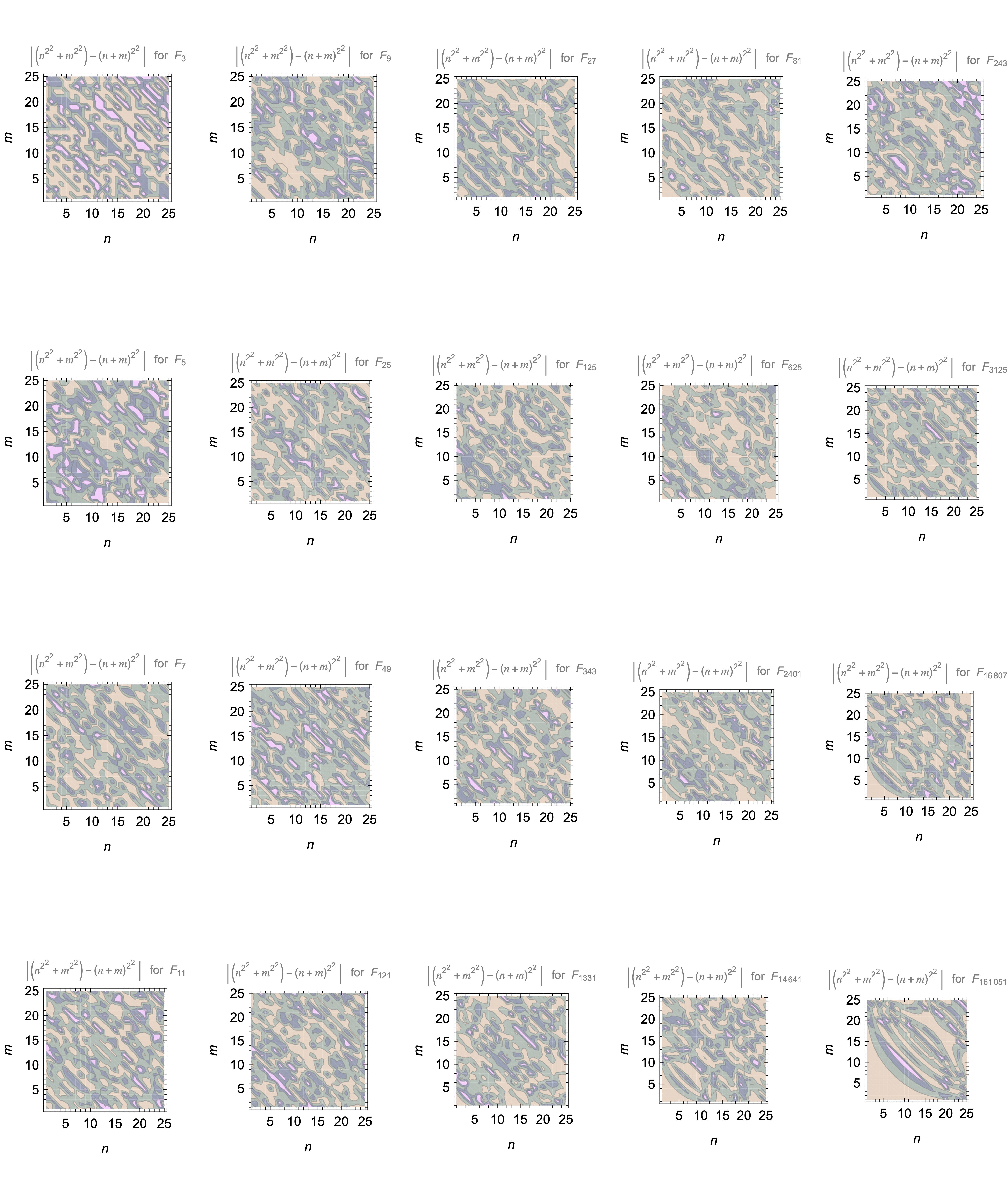
One can look at the error for different finite field and values of j:
The Problem With Universes and Labels
The way IUT deals with the erroneous equalities that result from the gluings is by assigning distinct labels to the data on either side of the gluings. That is to say, the image and pre-image of the map are given distinct labels in different universes so that their identification doesn’t yield a contradiction.
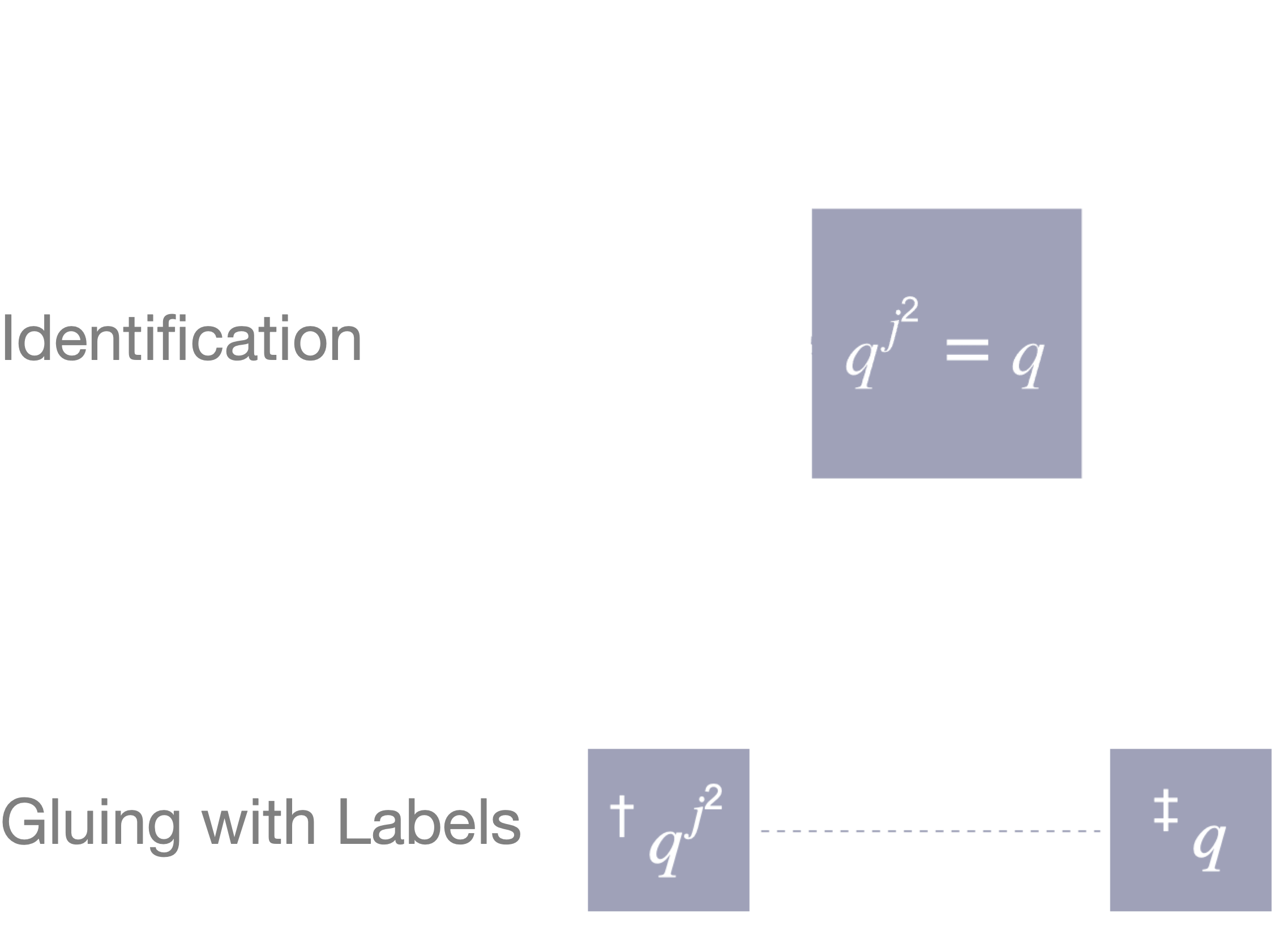
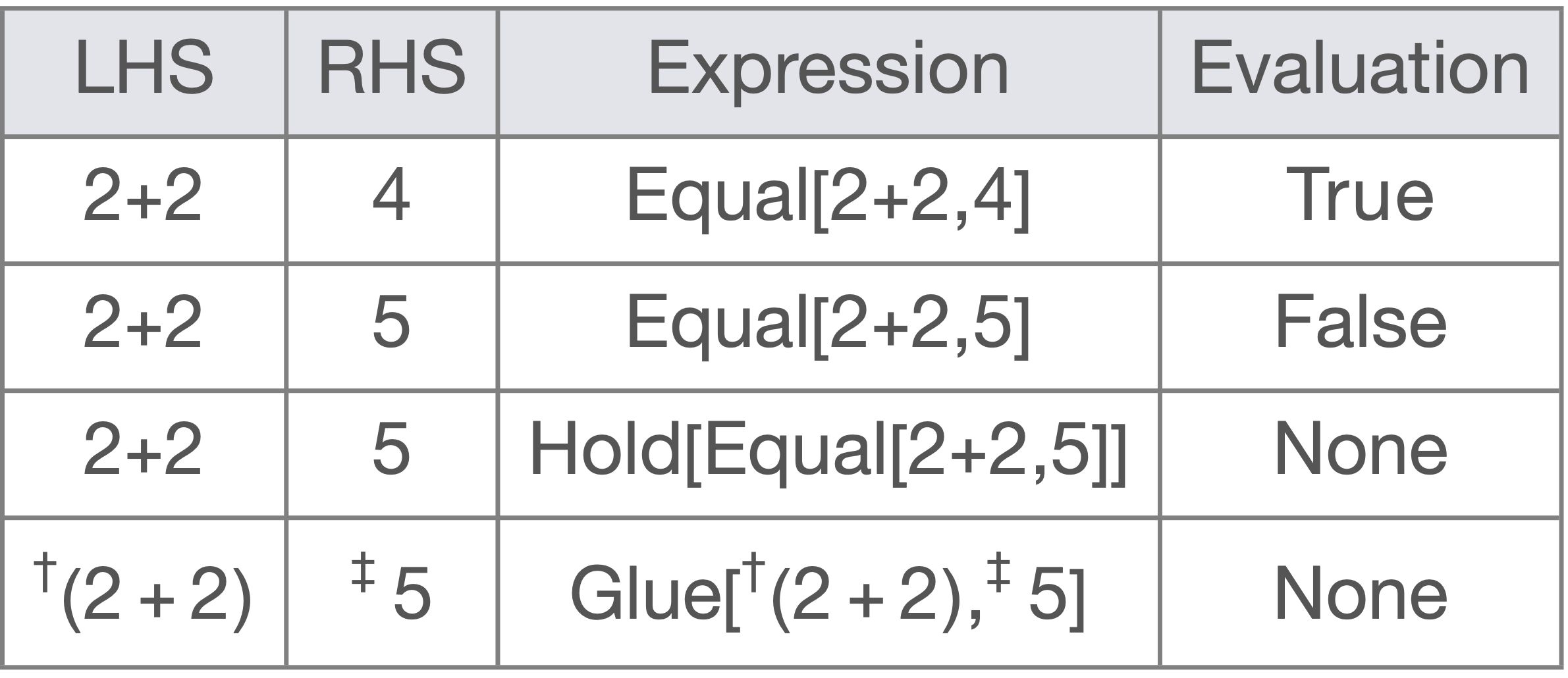
The only analogy I can make for this is something like the Hold command in Mathematica, which essentially allows one to write symbolic expressions without them being evaluated. So, for example, Hold[2+2=5] doesn’t evaluate to False, because it doesn’t evaluate at all. Alternatively, if one creates some novel symbols like †(2+2) and ‡5, the expression †(2+2)=‡5 also won’t evaluate because the labels effectively render it a symbolic expression rather than a numerical one. Technically, in mathematics, one can construct arbitrary symbolic expressions. The issue is that the arguments in these expressions, which include identifications, are arithmetic data that aren’t equal. So, this label “trick” looks something like this:
Mochizuki’s proof requires that these labels be kept in distinct to avoid contradictions from the gluings. In other words, even though the identifications are false, if we put the left-hand-side and right-hand-side in different universes, the data “don’t know” that they’re incorrectly identified. This is regarded by many as unsettling, as it allows one to manipulate incorrect statements by, in a sense, “preventing their evaluation” by keeping data separate.
Writing up this brief exposition after releasing a few others on several topics in number theory, I feel that the use of separate universes/labels runs very much contrary to the spirit that phenomena in number theory can always be computed concretely, and, when computed, often give miraculous results. I think IUT goes in the opposite, Bourbaki-like direction: with enough abstract structure, written solely in symbolic notation, one can go so far as to work with mappings and expressions whose computationally falsity is avoided by merely decorating objects and data with more notation.